
What Does a Chinese SUV Really Cost in Dubai, Lagos and Almaty?
The same $8,900 Chery costs $10,910 in Dubai and $15,020 in Lagos. And the cheapest route into Kazakhstan just got more expensive: Kazakhstan raised VAT to 16% on 1 January 2026, and most exporter guides still quote the old 12%.
China exported more cars than any country on earth in 2025, and the six models in this article are the ones buyers actually ask about: the BYD Song Plus DM-i, the MG ZS, the BYD Seagull, the Chery Tiggo 7, the Chery Tiggo 5x and the Haval Jolion. Together they cover the whole price ladder, from a $8,500 city car to a $23,500 plug-in hybrid SUV. The export numbers back the selection: the Song Plus was China's top export model of 2025 at 244,837 units, the MG ZS was second at 191,832, the Seagull third at 191,308 after growing 257%, and the Tiggo 7 was the top export of 2024 at 238,200. The Jolion is Russia's best-selling SUV by retail volume at 83,828, and the Tiggo 5x sits in Egypt's top ten.
This article prices all six in three destination markets — Dubai, Lagos and Almaty — as a buyer would actually pay at the port gate: the FOB price in China, plus the freight, plus the duty and tax stack. Every figure was captured on 24 November 2026 from named sources: exporter price lists, forwarder rate cards, dealer pages and tax summaries. Where a number could not be traced to a source, the article says so instead of printing it.
Which six cars, and what exactly is being priced?
The method is one formula, applied eighteen times: reference FOB, plus freight, plus the destination's duty and tax stack. The result is a port-gate landed cost — the car, cleared through customs, before local registration, dealer margin or delivery to the customer. Clearing and registration are excluded because they vary by broker and by city, and mixing them into the price would hide the comparison.
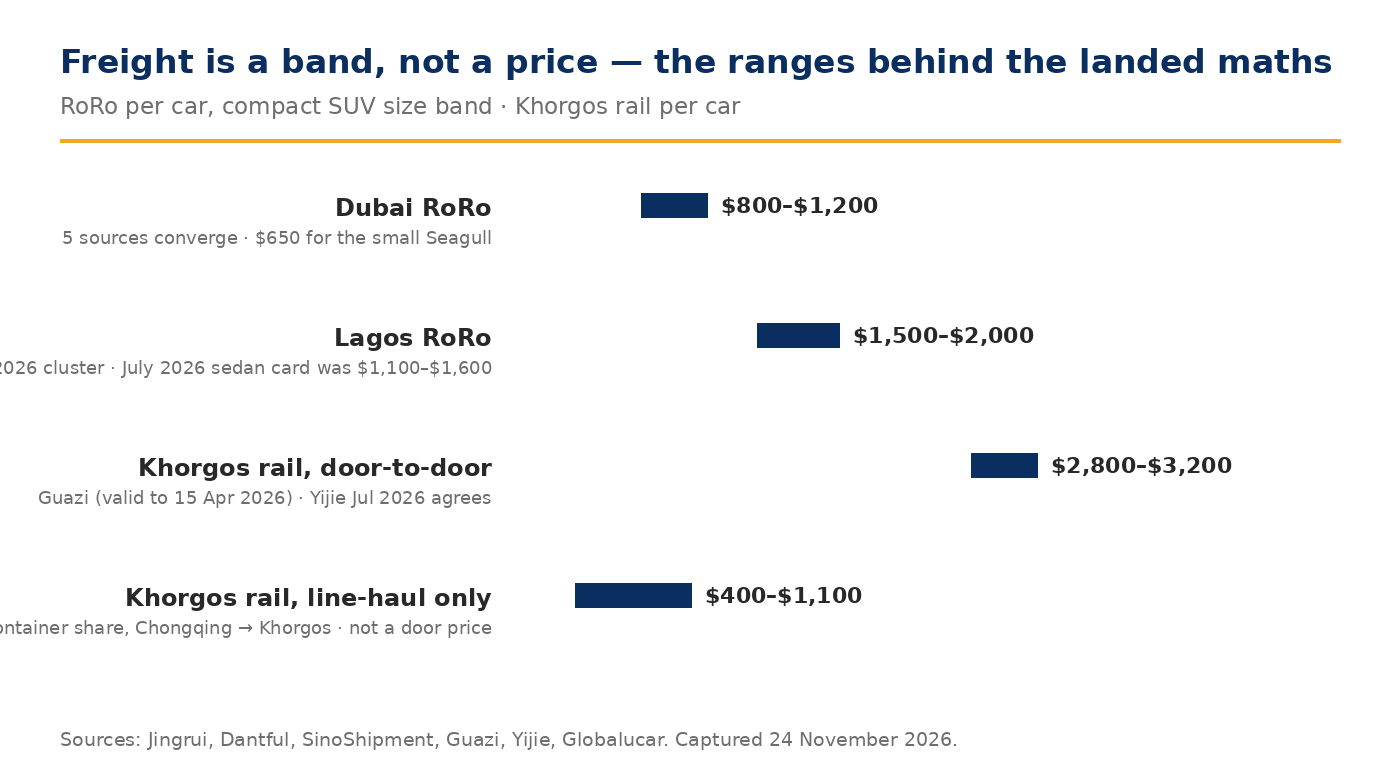
The reference FOB is the defensible middle of the observed range, not the cheapest listing. Dubai adds 5% duty plus 5% VAT, about 10.25% on the CIF value. Lagos adds roughly 41% of CIF for a petrol car, the figure Dantful's November 2026 Nigeria guide puts at 41–43%. Almaty adds the EAEU's 15% duty, then 16% VAT on the duty-paid value — a 33.4% stack. Freight is a size-band judgement, not a quote: RoRo to Jebel Ali is $800–$1,200 for a compact petrol SUV across five forwarder and exporter sources, Lagos is $1,500–$2,000 for the same size in November 2026, and door-to-door rail to Almaty via Khorgos is $2,800–$3,200.
Two rules shape the whole market and are worth knowing before any price. From 1 January 2026, cars must be registered in China for at least 180 days before export, and pure-electric cars need an export licence. Neither rule stops the trade, but both explain why so much of what is sold as "new" is not factory-fresh — a point the next section comes back to.
What does the same car cost in each city?
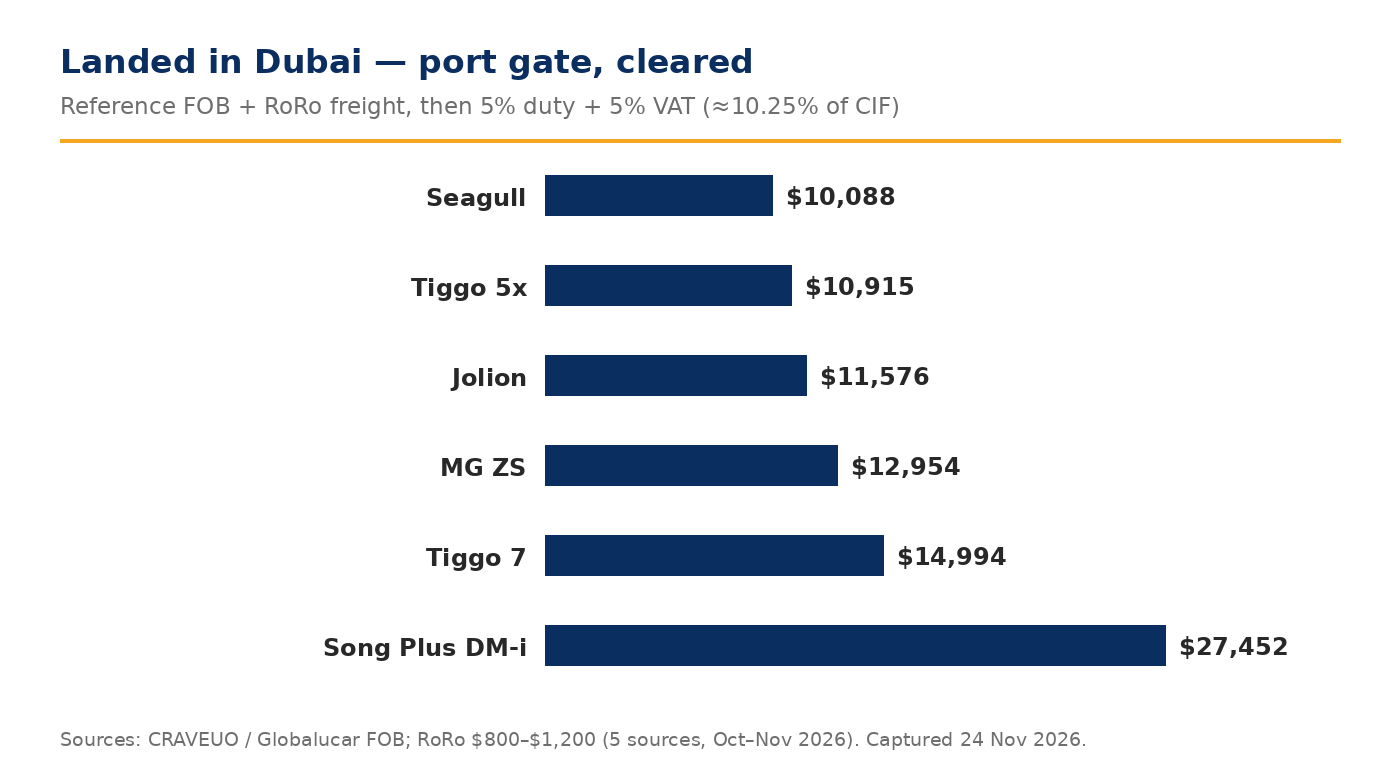
Dubai is the cheapest of the three by a wide margin, and the order is exactly what the FOB ladder predicts. The Seagull lands at $10,090, the Tiggo 5x at $10,910, the Jolion at $11,580, the MG ZS at $12,950, the Tiggo 7 at $14,990 and the Song Plus DM-i at $27,450. The Song Plus figure is not an estimate: Globalucar's own April 2026 landed-cost table puts the same car at CIF Dubai $24,900, and the 10.25% stack brings it to $27,450.
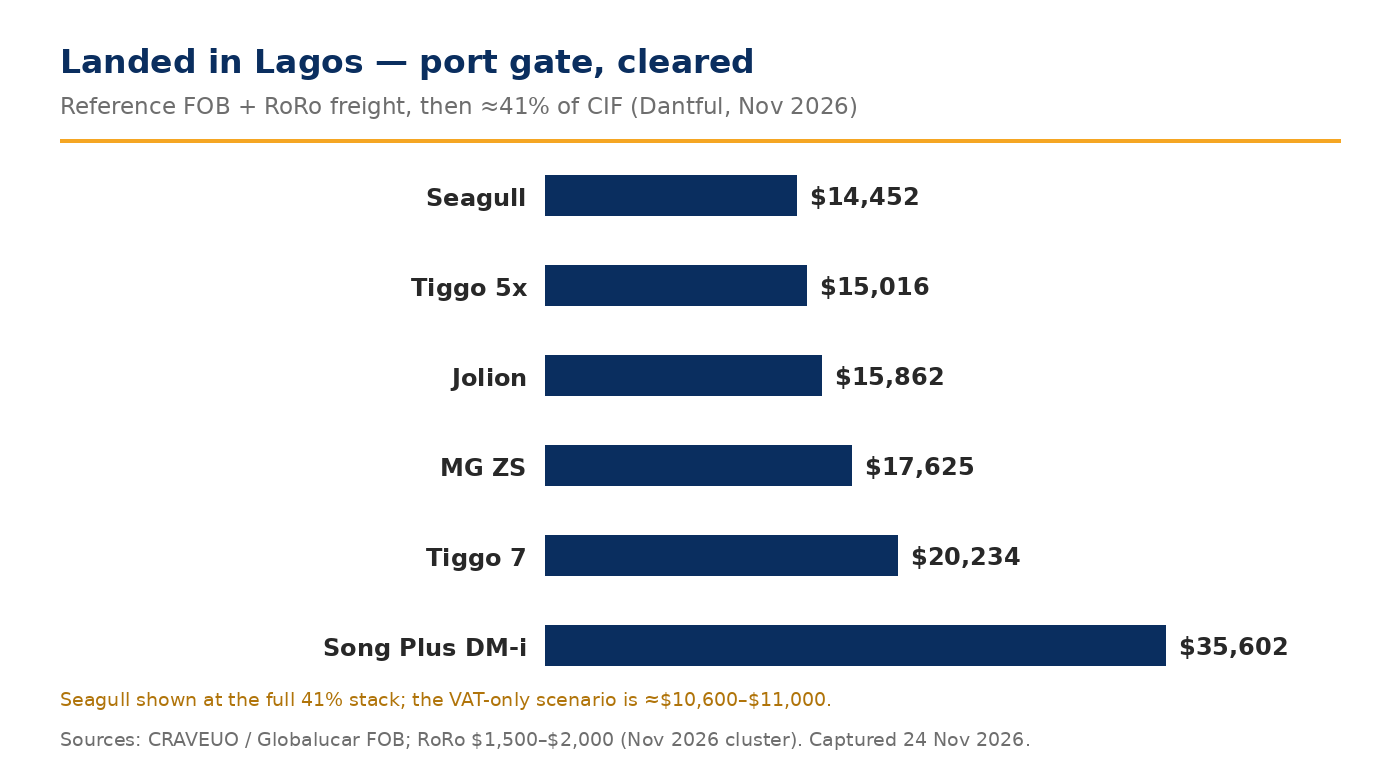
Lagos is where the table bites. The same six cars land at $35,600, $17,630, $14,450, $20,230, $15,020 and $15,860. The Tiggo 7 costs $5,240 more in Lagos than in Dubai — $14,990 against $20,230 — and the Song Plus costs $8,150 more. The 41% duty stack does most of the work, but the freight gap matters too: $1,500–$2,000 to Lagos against $800–$1,200 to Jebel Ali, and the November 2026 sources cluster higher than the July rate cards most guides still cite. If a quote shows Lagos freight at $1,350, it is using a July 2026 sedan card, not a November SUV rate.
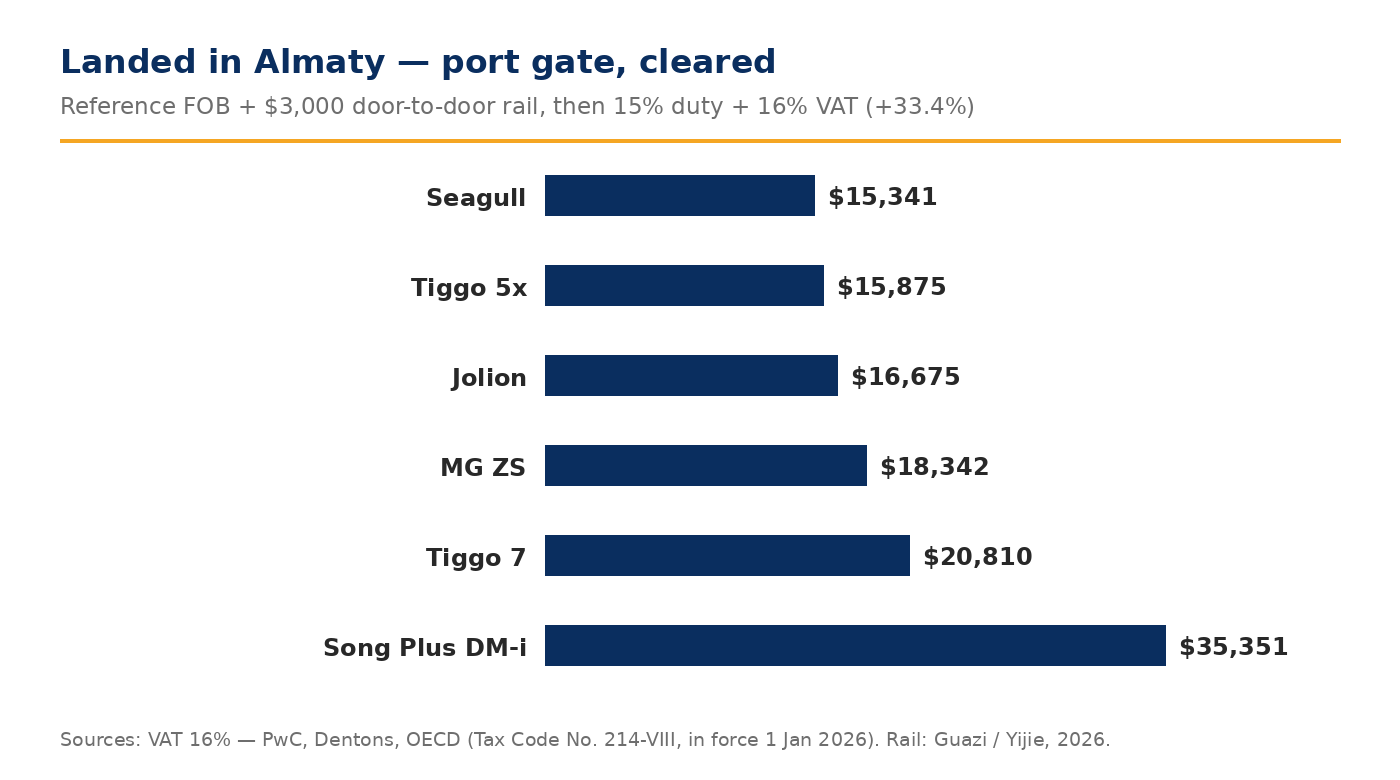
Almaty lands between the two for most models and above Lagos for the Song Plus: $35,350, $18,340, $15,340, $20,810, $15,880 and $16,680. The surprise is the spread. The Song Plus is nearly as expensive in Almaty as in Lagos, while the Tiggo 5x is only $860 dearer in Almaty than in Lagos. The reason is the stack's shape: Almaty's 33.4% applies to FOB plus rail, so the expensive car carries the heavier absolute tax, while the cheap car barely notices it.
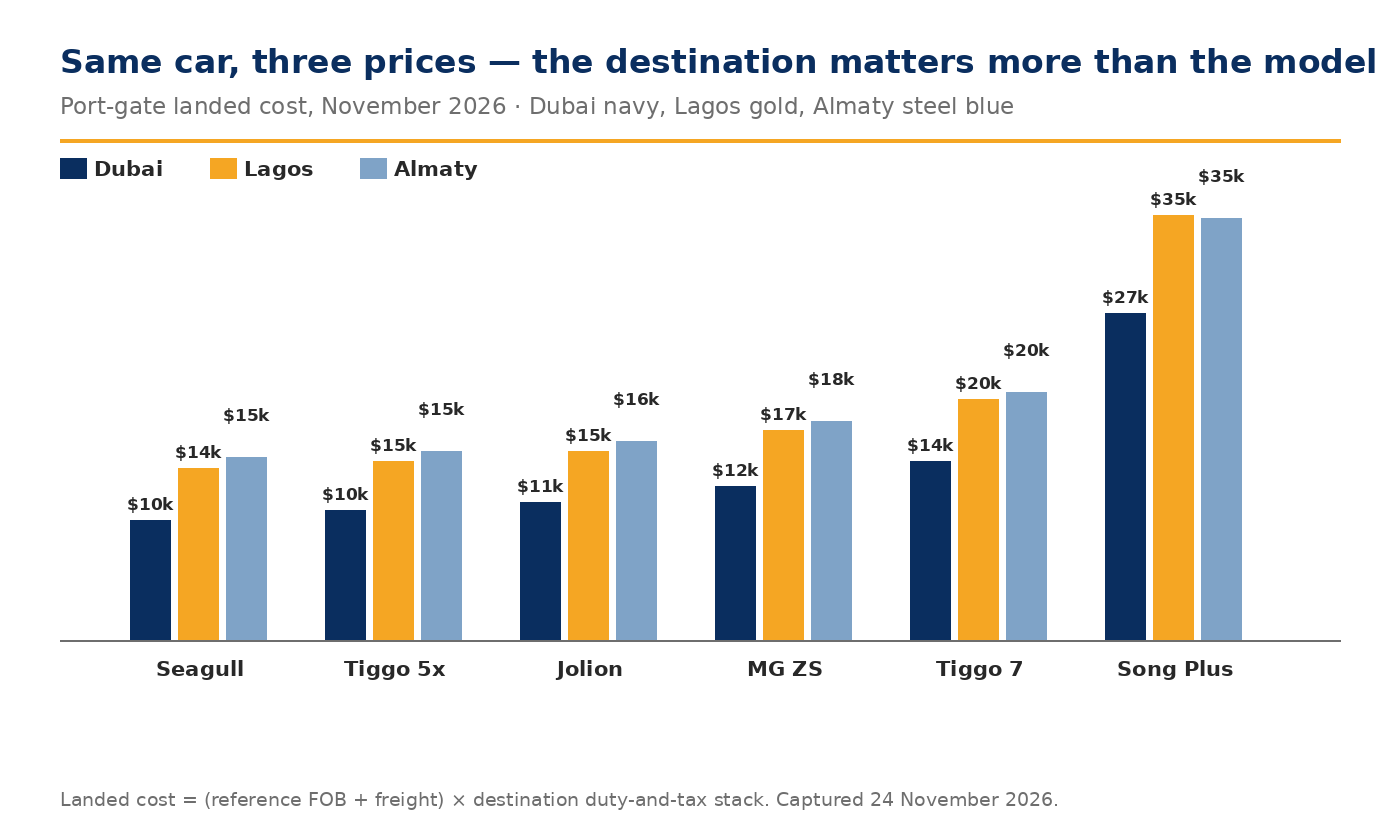
Read across the three charts and one pattern is unmissable: the destination matters more than the model. The Tiggo 5x in Lagos ($15,020) costs more than the Tiggo 7 in Dubai ($14,990), even though the Tiggo 7 costs $3,700 more at FOB. And the Jolion in Almaty ($16,680) lands $1,690 above the Tiggo 7 in Dubai — on a car that is $3,100 cheaper at FOB. Pick the city first, then the car.
Why is Almaty so expensive — and why is every guide wrong?
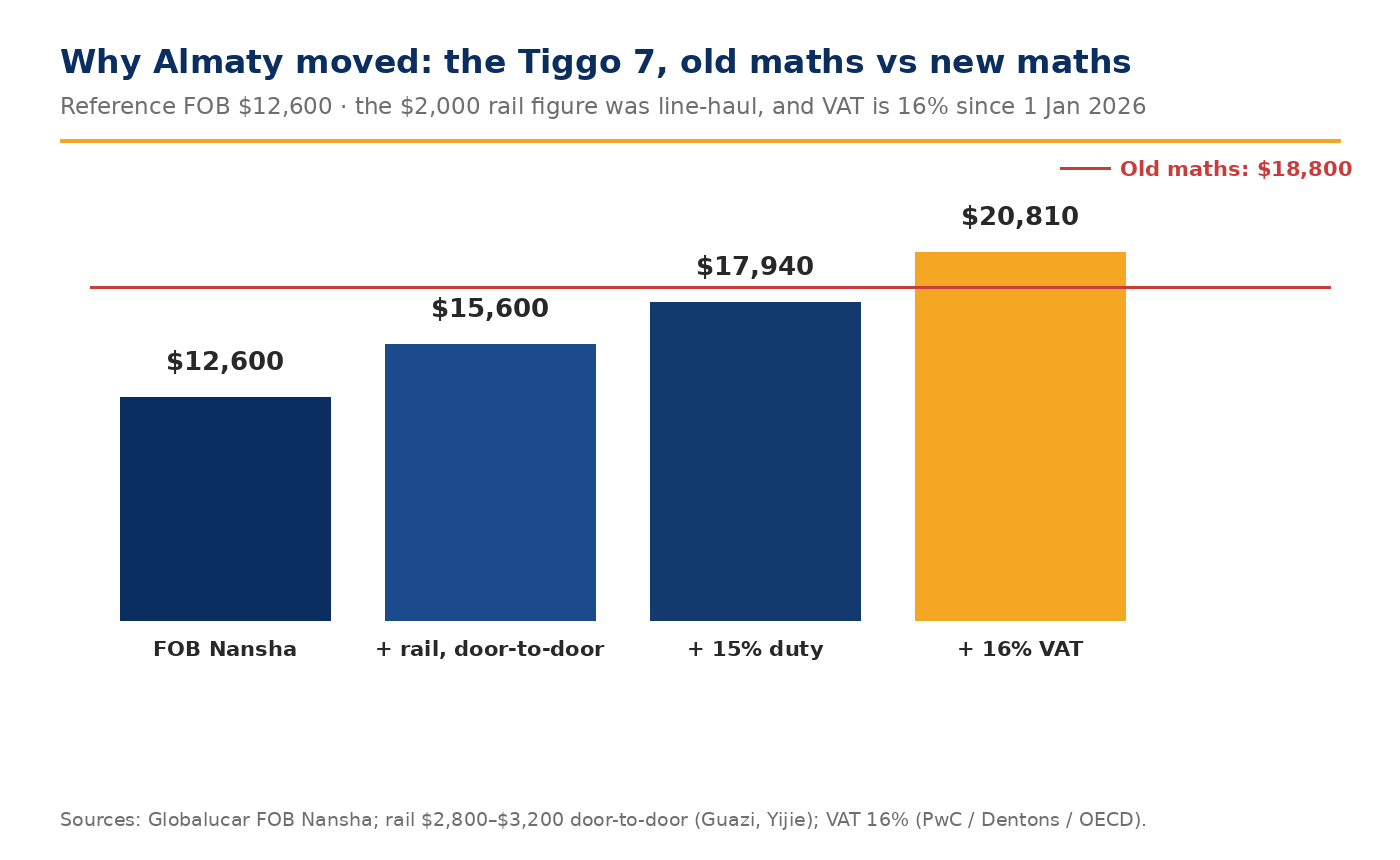
Two numbers changed, and most of what is published still uses the old ones. Kazakhstan's new Tax Code, signed on 18 July 2025 and in force from 1 January 2026, raised the standard VAT rate from 12% to 16%. PwC, Dentons and the OECD all confirm it, and Guazi's own Kazakhstan import guide uses 16% in its worked maths. Yet the Globalucar Changan guide from August 2026 still builds its Khorgos landing table on 12% VAT — a live example of the outdated figure circulating in exporter content.
The second number is the rail. The $2,000 per car that older tables use is a line-haul figure: Chongqing to Khorgos, $400–$1,100 per car depending on how many cars share a container. Door-to-door to Almaty — export clearance, border handling, delivery — is $2,800–$3,200, confirmed by Guazi's guide and by Yijie's July 2026 update. The $2,000 figure sits between the two scopes, which is exactly why it survived so long: it looks plausible against either range.
The combined correction is bigger than the VAT fix alone. Take the Tiggo 7, reference FOB $12,600. The old maths — ($12,600 + $2,000) × 1.288 — gives $18,800. The corrected maths — ($12,600 + $3,000) × 1.334 — gives $20,810, a $2,010 increase, or 10.7%. Across the six models the Almaty column rises 4.4% to 13.5% against the old figures, and the stack line that every guide prints as "+29%" should read "+33%". If a supplier's Almaty quote still shows the old stack, the quote is using January's tax law and a line-haul freight figure — ask for both to be restated before comparing it with anything else.
What does "FOB" actually buy you?
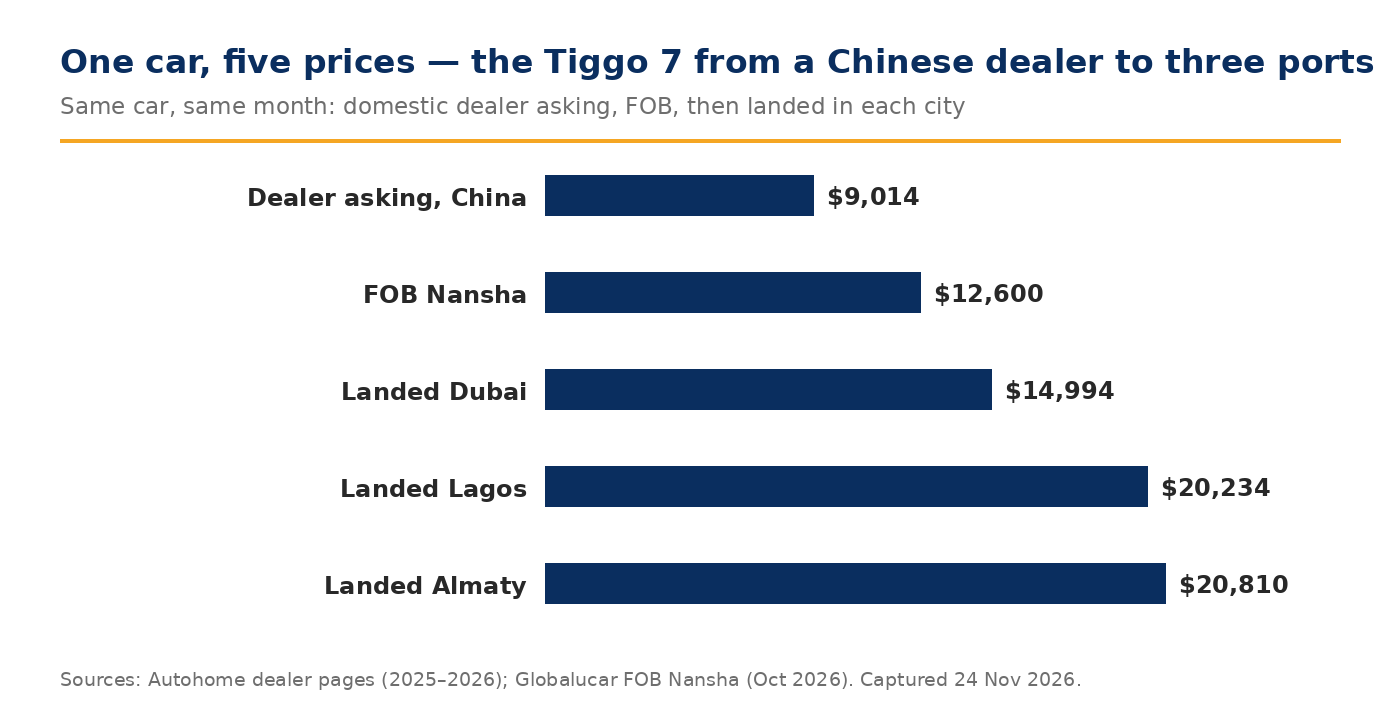
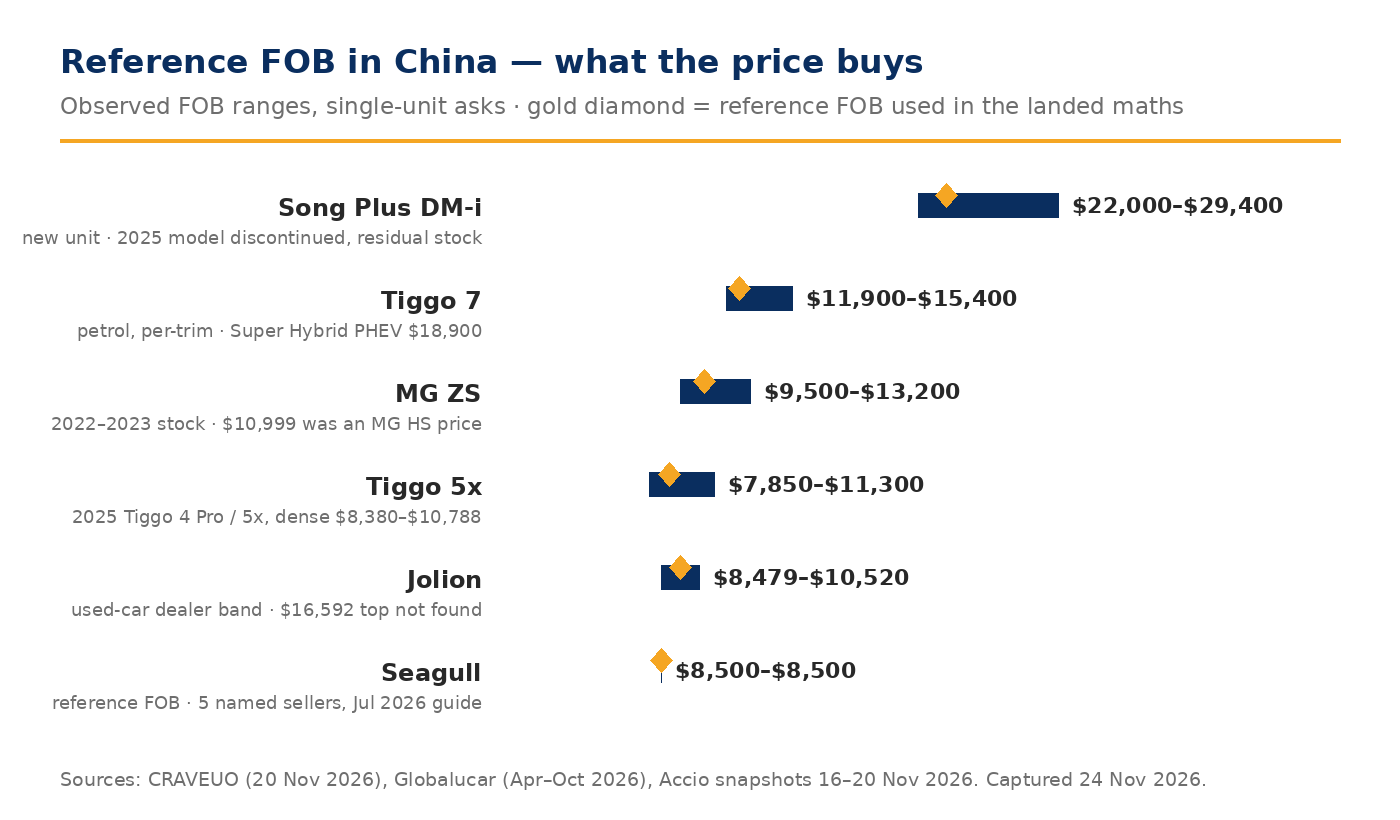
Here is the finding that changes how to read every price in this article: on the marketplaces where these cars are listed, "new" usually means 2021–2023 stock. Across the three marketplace models the modal listing is a 2022 model-year unit, often labelled "0km second car" by a used-car dealer. The FOB ranges below are therefore used and zero-mileage-stock ranges, not factory-new ranges — with two exceptions.
The Tiggo 7 is the clean exception. Globalucar publishes a per-trim FOB list from Nansha, updated around 6 October 2026: fleet $11,900, Prime $12,600, Prestige $14,300, all-wheel drive $15,400, and the Super Hybrid PHEV at $18,900 — a separate trim, not the top of the petrol range. The Song Plus DM-i is the second exception: CRAVEUO's per-trim table, updated 20 November 2026, runs $23,100 to $29,400, and Globalucar's GCC guide puts the floor at $22,000. But note the caveat: the 2025 Song Plus DM-i is discontinued in China, so new-unit FOB now means residual stock, and the sub-$20,800 asks that circulate are genuine used cars — 2021–2024 units at FOB $10,700–$11,000 — not bait, and not comparable to new-unit prices.
Two endpoints in the older tables are dead and should not be quoted. The MG ZS reference FOB of $10,999 is not a ZS price at all: on the seller's page the $10,999–$12,069 band belongs to the listing directly above it, the MG HS — a different model. The defensible ZS range is $9,500–$13,200, 2022–2023 stock, with a reference FOB around $10,750. And the Jolion's $16,592 top was not found anywhere: no listing at that price exists in the captures. The floor, $8,479, is real — the low end of a used-car dealer's $8,479–$10,520 band — and the honest reference is around $9,500, or the $13,200 equivalent-trim anchor Globalucar publishes. The Tiggo 5x range is $7,850–$11,300, dense between $8,380 and $10,788, with a reference around $8,900.
The domestic prices tell the same story from the other side. The Song Plus sells at ¥135,800–¥175,800 at list and ¥115,800–¥161,800 at dealers. The Tiggo 7 base line lists at ¥74,900–¥97,900, with dealers from ¥64,900. The Tiggo 5x 2025 model lists at ¥62,900–¥83,900, dealers ¥54,900–¥75,900. The MG ZS lists at ¥79,800–¥106,800, and no dealer asking could be captured at all. The Jolion has no domestic price: it has been export-only since 2021, and its last domestic price is the January 2021 launch range of ¥78,900–¥112,900. A car with no home market is priced entirely by the export market — which is why its FOB range is the least anchored of the six.
What is the cheapest ticket into each market?
Dubai's cheapest ticket overall is the Seagull at $10,090, and the cheapest SUV ticket is the Tiggo 5x at $10,910. That $10,910 is the number to remember: a current-model-year compact SUV, landed and cleared in Jebel Ali, for less than the domestic dealer price of a Tiggo 7 in China. The Tiggo 5x works because its FOB is low and its freight is the standard compact-SUV band — nothing exotic has to go right.
Lagos's cheapest ticket is also the Tiggo 5x, at $15,020. The Seagull looks cheaper at first glance — a VAT-only scenario lands it near $10,600–$11,000 — but that scenario depends on the electric-car treatment holding at 7.5% VAT only, and the full 41% stack puts it at $14,450. An importer budgeting the VAT-only number should confirm the treatment in writing before ordering, because the $3,500 difference is the whole margin.
Almaty's cheapest ticket is the Seagull at $15,340, with the Tiggo 5x just behind at $15,880. The Seagull's advantage is arithmetic: the 33.4% stack multiplies FOB plus rail, so the cheapest FOB wins twice — once on the car, once on the tax. For a buyer whose only question is the lowest landed cost in Central Asia, the small electric car beats every petrol SUV on the list.
What can't this table tell you?
Five gaps stay open, and they are the reason this table is a screening tool, not a quote. Dealer discounts are about eleven months old — the Autohome dealer pages behind the domestic prices are dated November 2025 to January 2026, and list prices do not move with them, but the discount column should be re-checked before publication. No per-model, SUV-size RoRo quote was found: all freight figures are size-band ranges, so the per-model points are judgements inside those bands. MG ZS dealer asking is still not captured anywhere, so the ZS row is list-price only. The Lagos duty composition is not itemised for new cars — the 41% is corroborated as a total, not broken down. And one conflict is named rather than hidden: EV.International lists higher China prices than the dealer captures — Song Plus $20,900–$27,800 against dealer asking $16,100–$22,500 — with no dealer listing corroborating the higher figures, so this article uses the dealer captures and flags the gap.
So what do you do with this?
Use the table to screen, then verify two numbers before paying anything. First, the trim-level FOB: the same model name spans $7,850 to $15,400, and the spread is trim and model year, not negotiation. Ask which trim and which model year the quote buys, and check it against the ranges above. Second, the freight size band: a compact SUV and a sedan do not pay the same RoRo rate, and a line-haul rail figure is not a door-to-door price. If either number in a quote is vague, the landed total is vague too — however precise it looks.
And verify the seller before the money moves. A price is only as good as the company behind it, and the marketplace listings behind these ranges include used-car dealers selling 2022 stock as new, a model name quoted from the wrong listing, and a price endpoint that does not exist. Checking the supplier — registration, export licence, real factory or trading status, and a quote in writing — costs far less than one car bought from the wrong one.
If you want that check done before you pay, Tavino runs it as a fixed-price service: a verified China supplier check, with registration, factory or trader status, red flags, and a price comparison against the ranges in this article.