
Where Are the Real US Buyers in Import Data?
The public record is free — and the top of it is freight forwarders. What 12 million plastic-parts shipments actually show, and how the real buyers get dug out.
In November 2026 I went looking for the real US buyers of plastic parts, in the most obvious place there is: the public import record. Every ocean shipment entering the United States generates a bill of lading, and most of that record is public. If you sell plastic parts, or buy them, the names of your customers (and your competitors' customers) are supposed to be sitting there, free for the reading.
They are. But the first name the record hands you isn't a buyer. It's a freight forwarder.
What follows is what that record actually shows, why the top of it belongs to logistics companies, and the method I use to dig the real buyers out from underneath them. I'm giving the method away in full. The method isn't the scarce part. The patience is.
What do US import records actually show?
The source is the vessel manifest system of US Customs and Border Protection (CBP). For every ocean shipment arriving at a US port, the carrier files a bill of lading: the shipper, the consignee, a notify party, a product description, a weight, and the ports at both ends. Large parts of that filing are public, and aggregators organize them into searchable databases. The figures here come from ImportYeti's free HS-code pages, pulled on 23 November 2026. The database itself was updated on 17 November 2026, and it covers sea shipments from January 2015 to November 2026.
I pulled two categories, the two that come up constantly in buyer research for plastic parts. HS 3925, builders' ware of plastics (doors, windows, blinds, trim), holds 333,509 sea shipments across that window. HS 3926, other articles of plastics, the catch-all, holds 11,924,138. Together that's more than 12.2 million bills of lading.
Two things about this data matter before you read a single name.
First, a bill of lading is a transport document. It names the parties to the shipment, not the parties to the deal, and those are often different companies. Second, every ranking on these pages is a lifetime ranking: January 2015 to November 2026, eleven years of accumulated shipments. It shows where volume has piled up. It doesn't show what anyone ordered last month.
Keep those two facts in mind and the strangest feature of the data stops being strange.
Why is the top of the list full of freight forwarders?
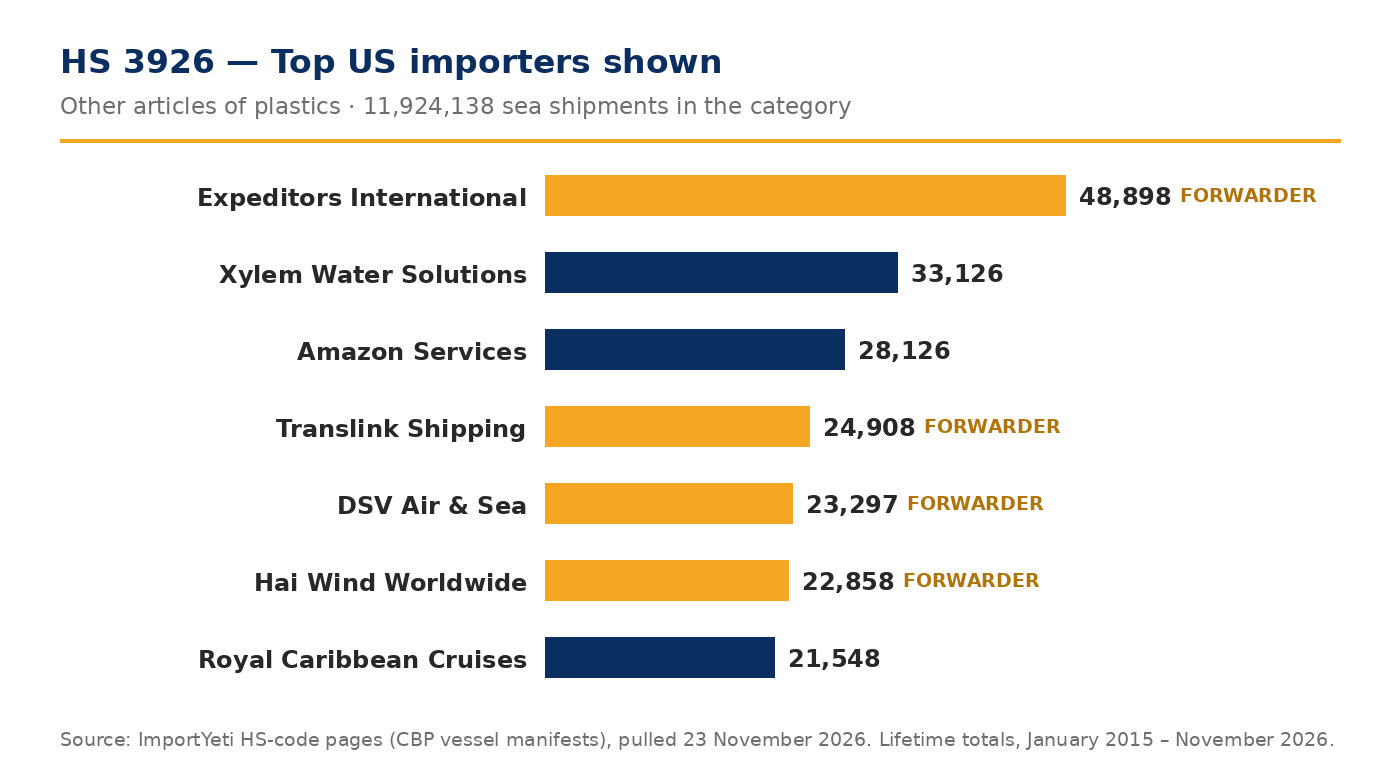
Open the importer ranking for HS 3926 and the largest "importer" of plastic articles into the United States is Expeditors International, with 48,898 shipments. Expeditors doesn't buy plastic parts. It moves other companies' cargo. And it isn't alone up there: of the seven top importers shown, four are logistics companies — Expeditors, Translink Shipping (24,908 shipments), DSV Air & Sea (23,297) and Hai Wind Worldwide (22,858). The genuine buyers in that list, companies like Xylem Water Solutions (33,126) and Amazon Services (28,126), sit in between the forwarders.
The supplier side is worse. The number-one "supplier" of HS 3926 is a name rendered as August Amber Hk, sitting on 549,261 bills of lading. That's about 4.6% of the entire 11.9-million-shipment category, under one opaque name. Below it, the top ten shown is stacked with logistics firms: Orient Express Container (42,543), Honour Lane Shipping (31,790), US United Logistics Ningbo (29,034), Penavico International Logistics (27,412), C.H. Robinson Freight Services (25,561). Consolidators and NVOCCs, companies that book container space and bundle other people's cargo.
One detail gives the game away. August Amber Hk also tops the supplier list of HS 3925, with 37,777 of that category's 333,509 shipments — more than one bill in nine, in a completely different product category. Factories specialize. Consolidators generalize. When one name leads two unrelated categories at that scale, you aren't looking at a manufacturer. You're looking at a pipe.
None of this is a database error. When a forwarder books the container and files the paperwork, the forwarder's name is what the record holds. So a raw "top US importers" export for a category like HS 3926 is, in large part, a directory of the logistics industry. Accurate, public, and useless as a buyer list until somebody cleans it.
When does the same database read clean?
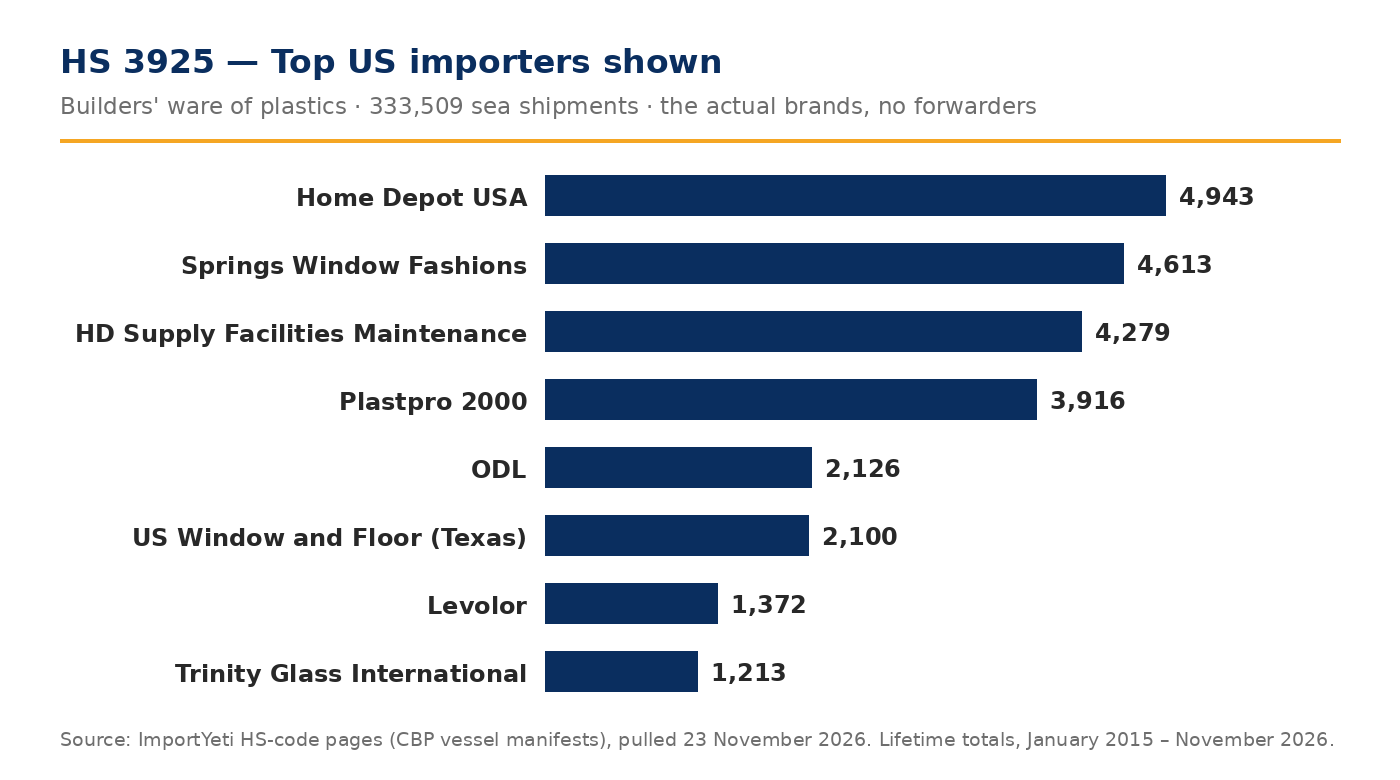
Now open HS 3925. The top importer is Home Depot USA, with 4,943 shipments. Then Springs Window Fashions (4,613), HD Supply Facilities Maintenance (4,279), Plastpro 2000 (3,916), ODL (2,126), US Window and Floor of Grand Prairie, Texas (2,100), Levolor (1,372) and Trinity Glass International (1,213). Every one of those sells windows, doors, blinds or building products. No forwarders. The buyers are simply there.
Same database, different category. Builders' ware is brand-direct: a small number of large brands import finished product under their own names, in their own containers, on repeating schedules, so their names land on the paperwork because they did the importing themselves. HS 3926 has the opposite structure. Thousands of small, unrelated products move through whoever will carry them, so the paperwork names the carriers.
One caution on scale, because the numbers invite over-reading. Even Home Depot's 4,943 shipments are under 1.5% of HS 3925's 333,509. These categories are long-tailed; the top of the list is the visible tip of a fragmented trade, in the clean category as much as in the dirty one.
The working rule: the same public record is a buyer list in a concentrated, brand-direct category, and a logistics directory in a fragmented one. You can't tell which one you're holding until you read the names, not the numbers.
How do you find the real buyer underneath?
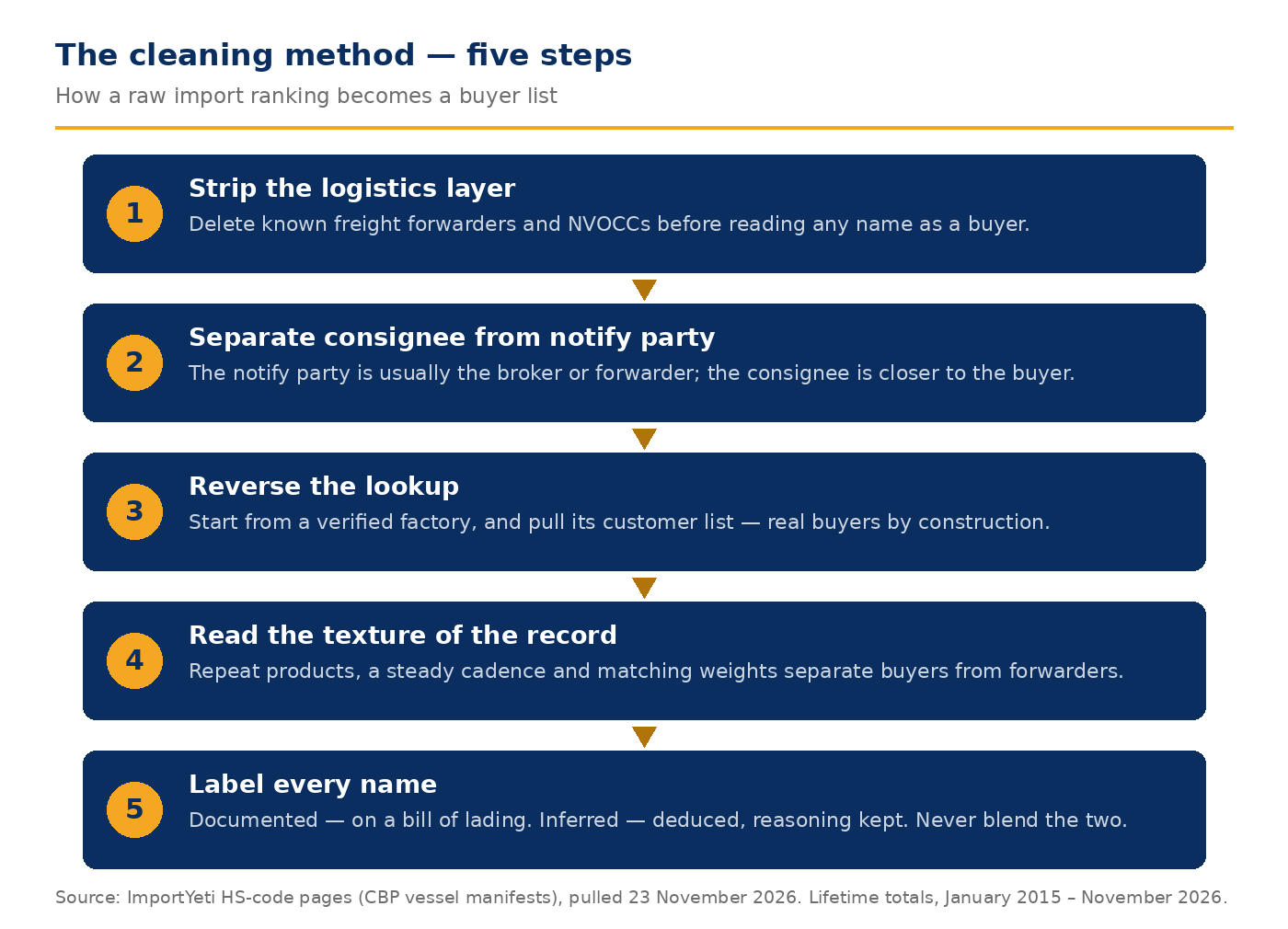
Here is the cleaning method, in full. It's the same sequence I run whether the output is for a client or for my own sourcing work.
Step one: strip the logistics layer. Delete the known freight forwarders and NVOCCs before reading any name as a buyer. In the HS 3926 importer list, that single pass removes Expeditors, Translink, DSV and Hai Wind from the top seven shown, and it changes every conclusion you'd draw from the list.
Step two: separate the consignee from the notify party. A bill names both. The notify party is very often the customs broker or the forwarder, the party who needed to know the ship had arrived. The consignee sits one step closer to the buyer. Lists built from the wrong field are forwarder lists wearing a buyer list's clothes.
Step three: reverse the lookup. Start from the other end. Take a supplier you've already verified, a real factory with a real export history, and pull its customer list. A verified factory's buyers are real buyers by construction. It's slower than downloading a ranking, and that's exactly why the results are worth more.
Step four: read the texture of the record. A genuine buyer repeats: the same product descriptions, a recognizable cadence of shipments, weights that match the product. A forwarder's record is a random walk through every product on earth. Ten minutes of reading raw bills separates the two more reliably than any ranking does.
Step five: label every name. Each surviving name gets one of two labels. Documented: the name appears on a bill of lading in the role claimed for it. Inferred: the name is deduced from relationships, patterns and cross-references, with the reasoning kept. The two labels never blend. The moment a list lets an inferred name dress up as a documented one, every other name on it becomes suspect.
That's the whole method. It isn't complicated. It's just slow, and it doesn't scale by downloading, which is precisely why raw lists are cheap and cleaned ones aren't.
What can you never find in this data?
The holes matter as much as the method, because the holes are where money gets wasted.
Some buyers are invisible by law. US importers can ask CBP to keep their names confidential in the public manifest record. A buyer who has done that doesn't appear. Not at the top of the list, not at the bottom. Absence from the record proves nothing about whether a company imports.
Others import entirely under someone else's name: a buying agent, a consolidator, a forwarder's house name. That's the August Amber pattern, one name standing in front of hundreds of thousands of bills. The buyers behind such a name exist, and they buy at scale. The public record will never name them, and any list that claims to name them is guessing.
Air freight leaves no trace here either. These are sea records. Plastic parts that move by air (urgent, high-value, low-weight) simply aren't in the database. For some product lines, that's most of the flow.
And a lifetime ranking is not a market. Every figure in this article accumulates January 2015 to November 2026. A company can sit high on a lifetime list on the strength of shipments from early in that window and have ordered nothing since. The record is a history book. Readers who treat it as a live feed of demand are reading it wrong, usually at the exact moment they pay for it.
So is production really leaving China?
The claim most often attached to this data is that production is leaving China for Vietnam. The bills pulled on 23 November 2026 support a narrower statement.
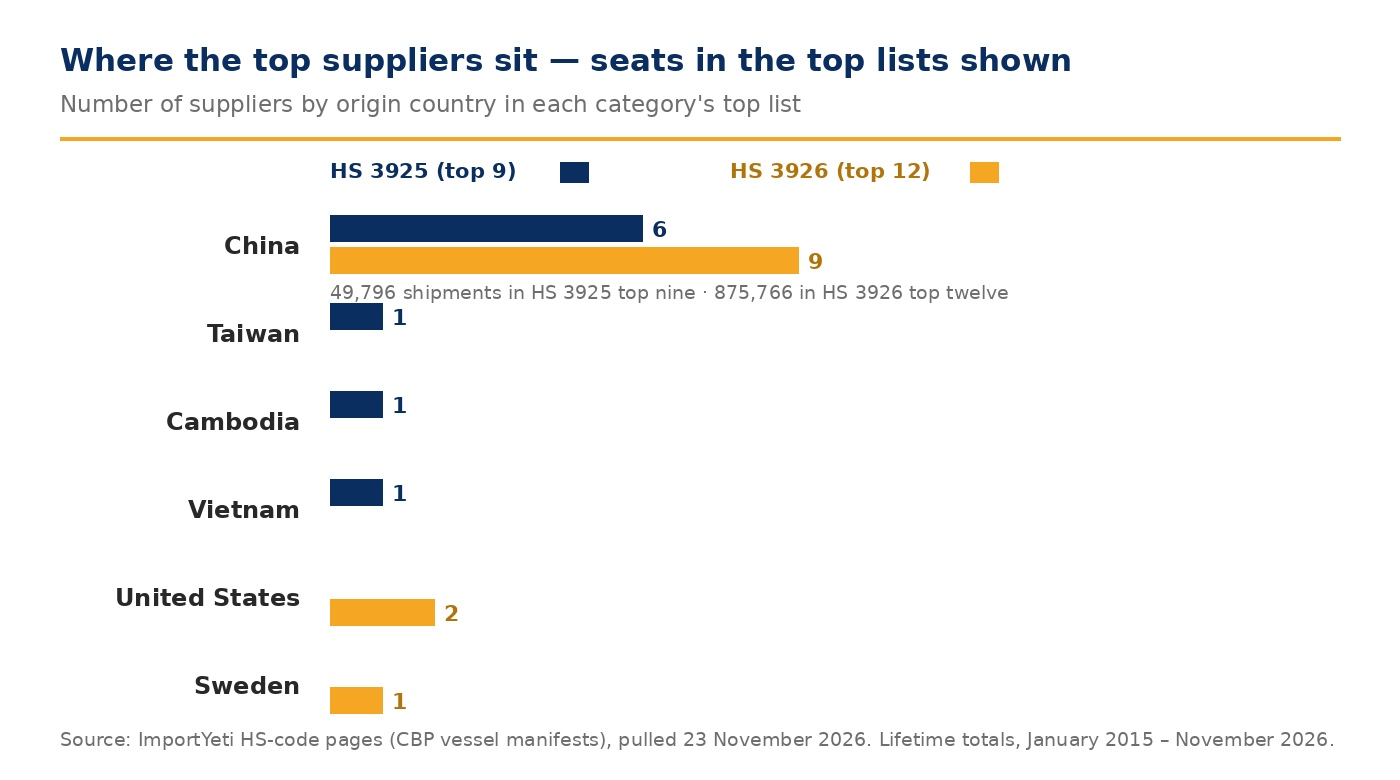
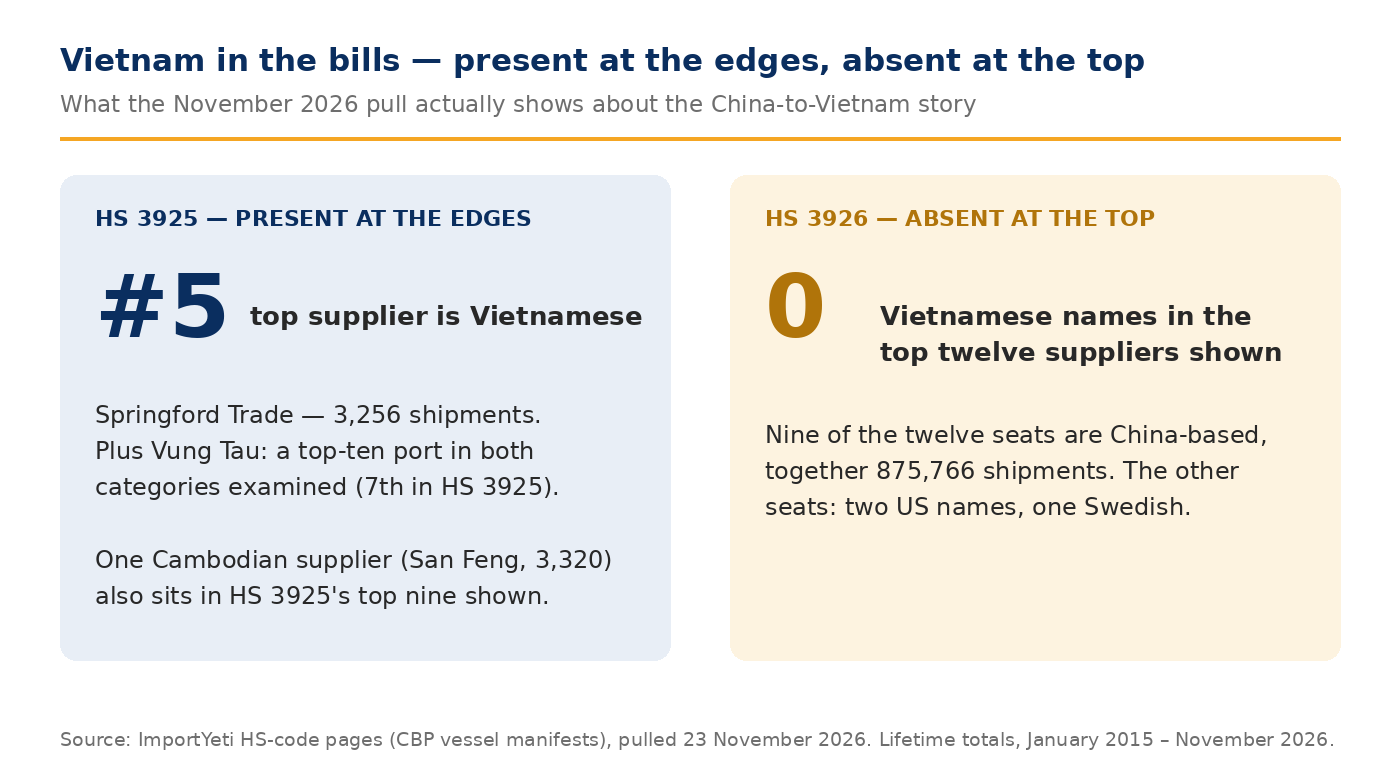
In HS 3925, of the top nine suppliers shown, six are China-based, together accounting for 49,796 shipments. The rest of that top nine is one Taiwan supplier (Nan Ya Plastics, 6,153 shipments), one Cambodian supplier (San Feng, 3,320) and one Vietnamese supplier (Springford Trade, 3,256, ranked fifth). On the port side, Vung Tau in Vietnam appears in the top-ten port list in both categories examined, seventh in HS 3925's list. Houston, Texas appears tenth in HS 3925's port list: whichever origin wins, the demand end of this trade lands in the United States.
In HS 3926, the top twelve suppliers shown contain nine China-based names, together 875,766 shipments, two US names and one Swedish name (Xylem Europe, 33,718). Vietnam's count in that top twelve is zero.
Diversification is real. It's also marginal. It shows at the edges of the smaller, brand-direct category and in the port lists, the places where a shift would surface first. At the top of the big category, China-based names still hold nine of twelve seats. The narrative of a completed move out of China is running ahead of the bills of lading. As of November 2026, the manifests describe a China-centered trade with a growing fringe, not a relocated one.
One limit, stated plainly: lifetime top lists show accumulated volume, not growth rates. Vietnam could be the fastest-growing origin in both categories and these tables wouldn't prove it. What they do disprove is the stronger claim, that the center of gravity has already moved.
What should a buyer list look like before you pay for one?
If you buy buyer research, from anyone, hold it to the standard this data forces on you:
- Scoped. One HS category, one stated window. A list that can't tell you its category and its dates isn't research; it's a spreadsheet.
- Forwarder-free, or forwarder-flagged. Logistics names stripped out, or labeled as what they are. If Expeditors appears as your top "buyer", you've bought a directory of the shipping industry.
- Traceable. Every name either Documented, with bills behind it, or Inferred, with the reasoning available on request. No third category.
- Dated. You know when the list was pulled and how fresh the underlying database was. For the figures in this article: pulled 23 November 2026, from a database updated 17 November 2026.
- Honest about its holes. Confidential names, agent-name importing, air freight. A serious list declares what it cannot contain.
Meet those five tests, and a buyer list is a working tool. Miss them, and it's what the raw top of HS 3926 is: a very accurate list of the wrong companies.
If you'd rather do it yourself, the five steps above are the whole method. The only ingredient it really needs is the patience.