How to Verify a 1688 Supplier Before You Pay
The shop said nine years. The company behind it was two. What a five-step desk check found on a real Dongguan watch-parts supplier — before any money moved.
Last week I checked a watch-parts supplier in Dongguan for a buyer who was about to order GA-2100 mod kits — the metal case-and-strap sets that turn a Casio G-Shock into something that looks ten times its price. The parts themselves were fine. The listings looked professional, the prices sat right in the middle of the market, and the shop carried platform badges most buyers never question.
Within an hour, the check had surfaced two findings that changed the order: the company legally behind the shop had been registered barely two years earlier — not the nine years the storefront implied — and the factory, production lines and patents shown in the shop's photos belonged to a sister company, not to the seller of record.
Neither fact makes the supplier a scammer. Both facts change what a careful buyer does next: smaller first order, sample first, payment terms that assume less history than advertised. That is the whole point of verification. This article walks through the five checks I run on any 1688 supplier before money moves, using that real case — names removed, numbers intact — to show what each check can and cannot prove.
Can you trust a 1688 storefront at face value?
Short answer: no — and not because most sellers are dishonest. A 1688 storefront is a marketing surface. The "years in business" counter measures how long the shop account has existed, not the legal entity you would actually contract with. Badges are issued by the platform, but they certify the entity that passed verification — which may be a sister company, a predecessor, or a trading arm. Photos of factories and production lines are uploaded by the seller.
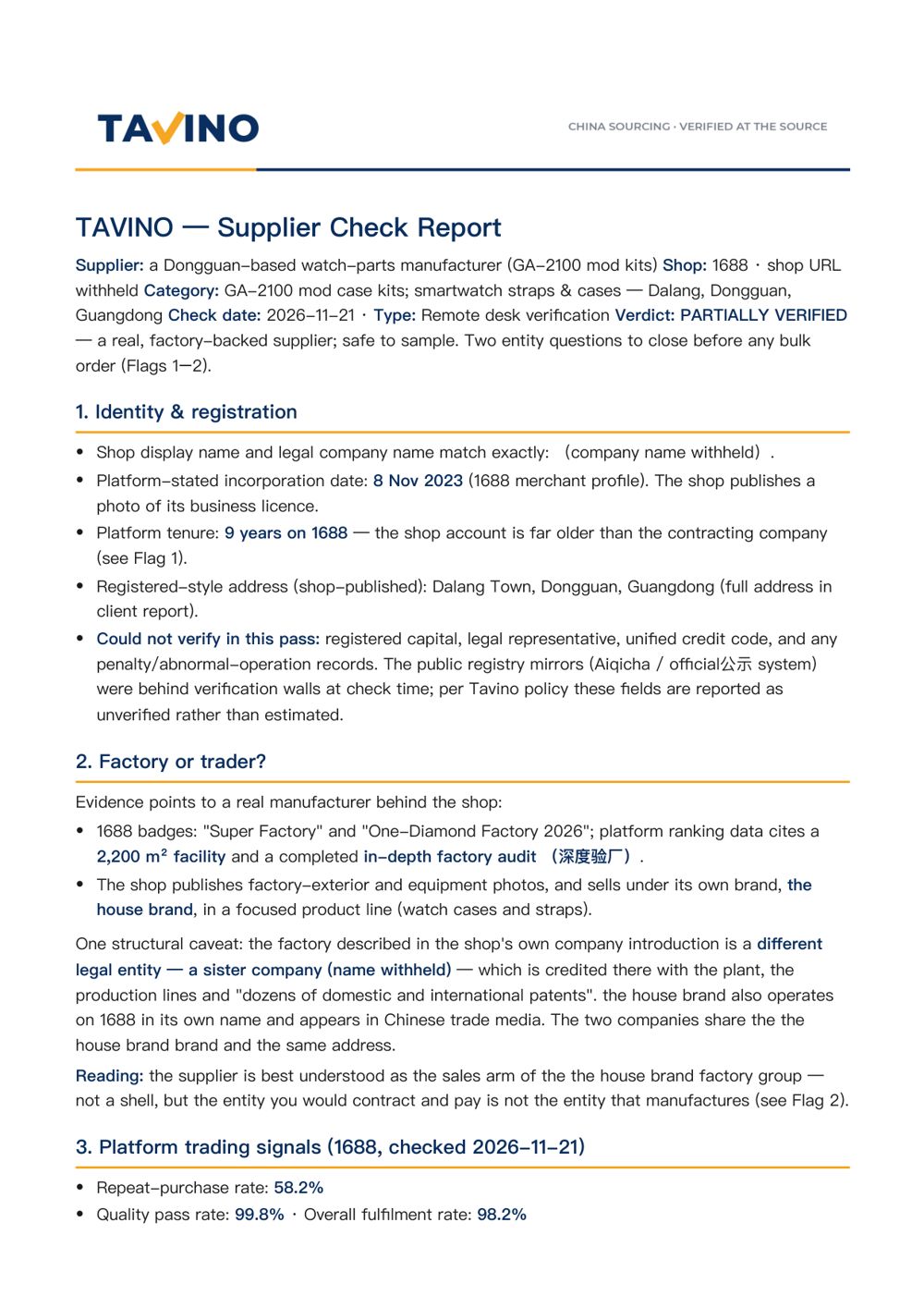
In the Dongguan case, the storefront said nine years. The business registry said the contracting company was incorporated on 8 November 2023. The factory shown in the photos — 2,200 m² in Dalang town, with audited production lines — belonged to an affiliated technology company under the same brand and address. Every individual claim was arguably true. The composite impression was not.
So the working rule is simple: treat the storefront as a set of claims, and verify each claim against a source the seller does not control.
What does the business registry actually say?
This is the highest-value check and the one most overseas buyers skip, because Chinese registry data sits behind Chinese-language interfaces. What you are looking for is boring and decisive: the company's full legal name, its incorporation date, its registered business scope, and whether it is still active.
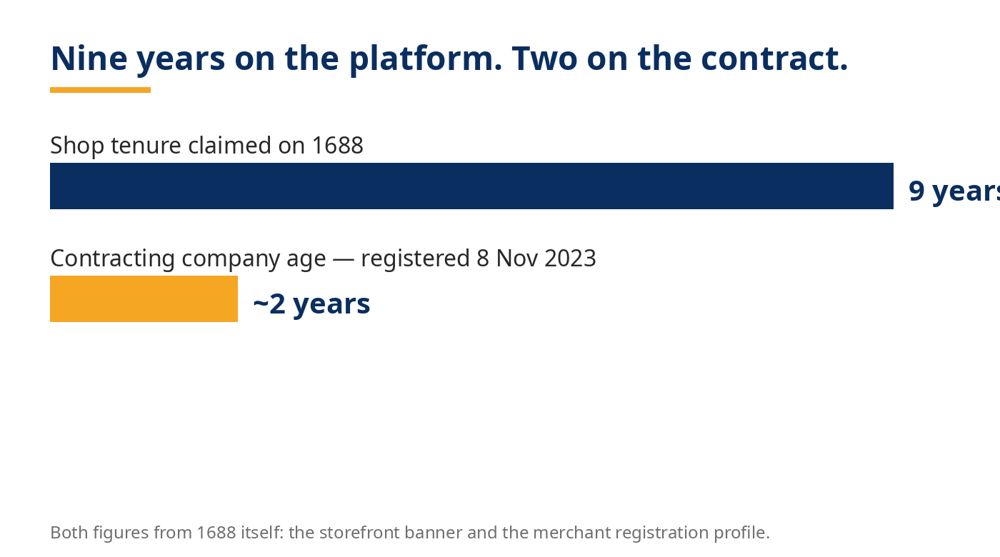
In our case: the shop presented nine years of history; the registry showed a company registered in November 2023 — roughly two years. A two-year-old company is not a disqualification. But it reprices the risk. A buyer who believes they are dealing with a nine-year manufacturer will happily wire a 30% deposit on a large first order. A buyer who knows the entity is two years old orders samples first and keeps the first production run small. Same supplier, different exposure.
Two more registry details are worth the extra minutes. First, business scope: if the registered scope does not include manufacturing, you are probably dealing with a trader regardless of what the storefront says — again, not fatal, but it changes who actually controls quality. Second, address consistency: the registry address, the platform address and the address on any proforma invoice should tell the same story. In the Dongguan case they did — one of several points in the supplier's favour.
What the registry cannot tell you: whether the company ships good product, or ships at all. It establishes who you are contracting with. Performance is a separate check.
Which platform signals are worth reading?
1688 publishes more performance data than most buyers realise — it is just scattered across the shop page in Chinese. The signals I weight most, with this supplier's actual numbers:
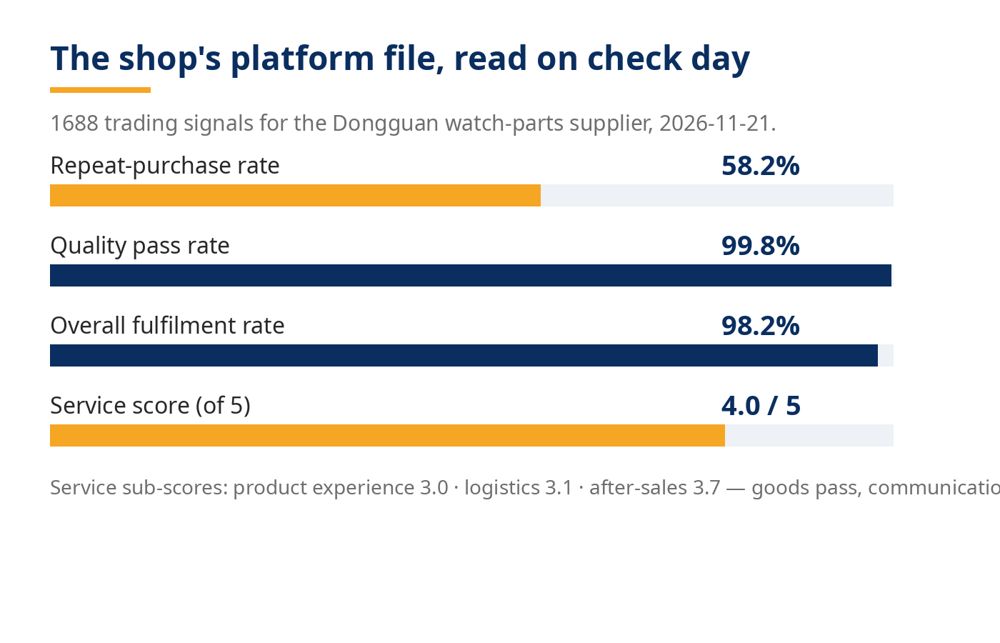
Repeat-purchase rate: 58.2%. Buyers come back. For components, that is one of the strongest soft signals available, because repeat buyers have inspected the goods.
Quality-inspection pass rate: 99.8%, and a fulfilment rate of 98.2%. Both are platform-measured, not self-reported.
Service score: 4.0 out of 5 — and here the detail matters. The breakdown was product experience 3.0, logistics 3.1, after-sales 3.7. The goods pass inspection; the experience around the goods is mediocre. For a buyer, that translates to: expect slow replies and average packing, not defective parts.
The target SKU itself: 5.0 stars across 200+ reviews, 70+ units sold, and a shop following of 2,856. A listing with that depth of history is hard to fake.
Read together, the platform data said: real operation, real product, average service. That is a workable profile — as long as the price is right, which is its own check.
Is the price inside the market band?
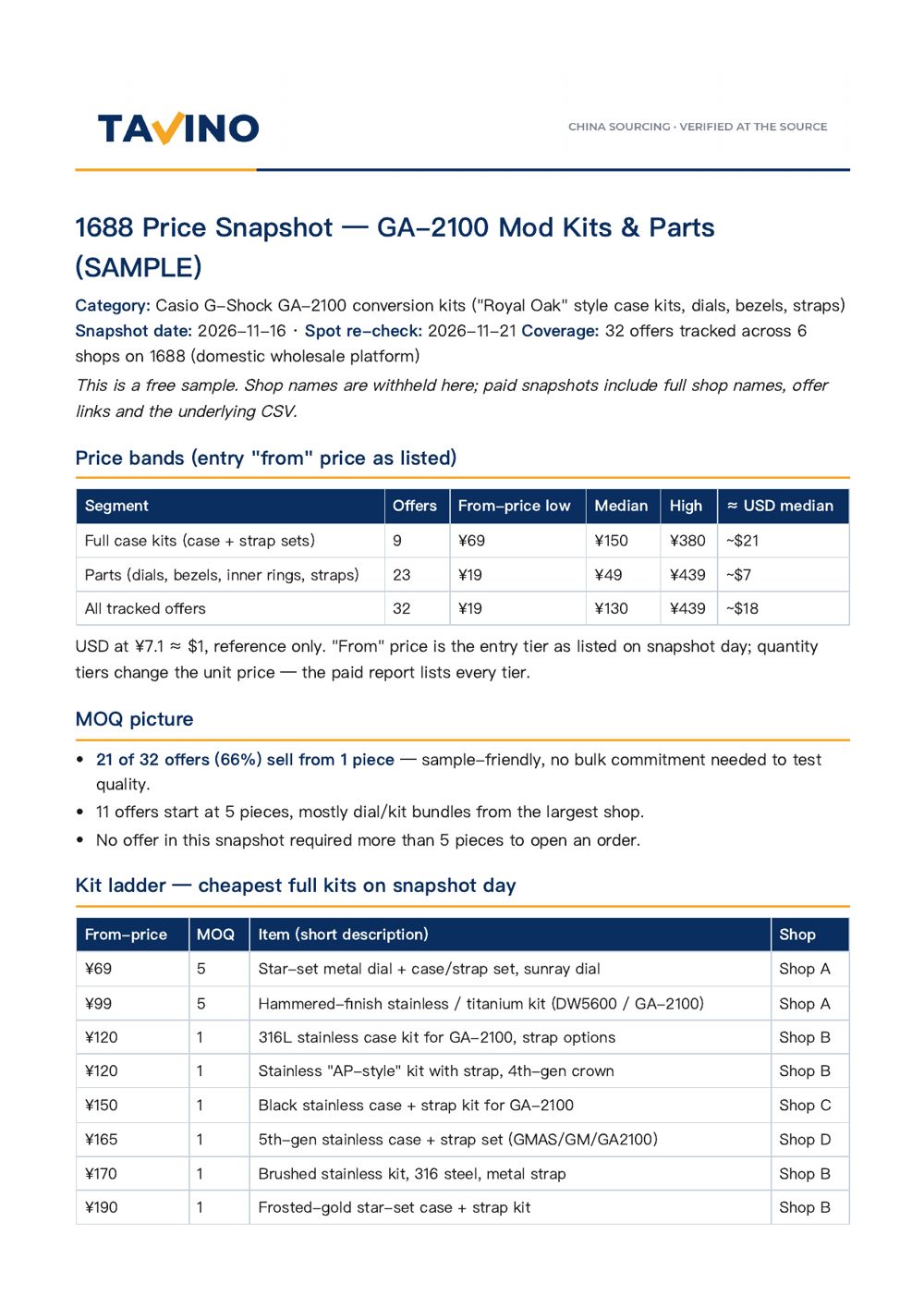
A supplier can be real and still be the wrong place to buy. So for every check I pull a category snapshot: the same product, priced across multiple shops, on the same day.
For GA-2100 full mod kits, my snapshot covered 6 shops and 32 listings. Complete kits ranged from ¥69 to ¥380, with a median of ¥150. Two-thirds of listings accepted single-piece orders — useful leverage, because it means samples are cheap and nobody has to commit to 500 units blind. One Shenzhen shop alone carried 16 of the 32 listings, which tells you where this category actually concentrates.
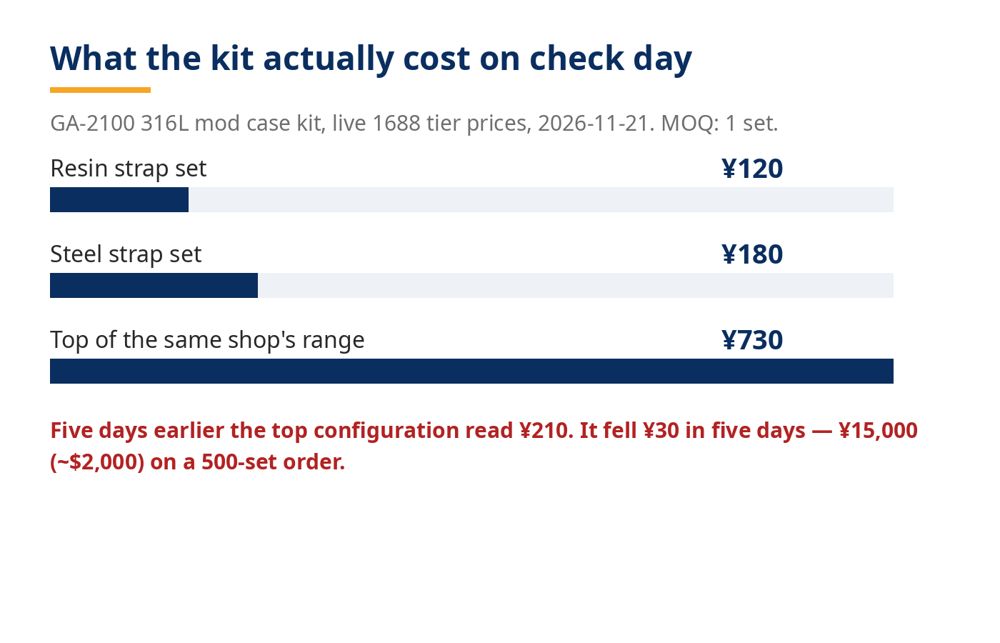
Against that band, the Dongguan supplier quoted ¥120 for the resin-strap kit and ¥180 for the steel-strap kit — inside the band, below the median on the steel version. Fair. Not the cheapest, not an outlier.
The snapshot also caught a movement that matters more than any single price: five days earlier, the same steel kit had been ¥210. A ¥30 drop on a ¥180 item is 14%. On a 500-kit order, ordering on the wrong week costs ¥15,000. Prices on 1688 move like this constantly, and a quote is a photograph, not a promise — which is why any serious order re-checks the price on the day the deposit is paid, not the day the supplier was found.
What could I not verify?
An honest report has a section like this one, and it is the section that separates verification from marketing.
Three things stayed unverified on the Dongguan supplier. First, direct contact details: the phone and messaging contact published on the shop could not be confirmed against a second independent source, so the report flags them as shop-published only. Second, the factory relationship: the production lines and patents belong to a sister company. Same brand, same town, same address cluster — plausible and common in Chinese manufacturing groups — but the legal link between the two companies could not be documented from public sources. Third, export experience: nothing in the public record showed whether this entity had ever shipped overseas, which matters for packing standards and paperwork.
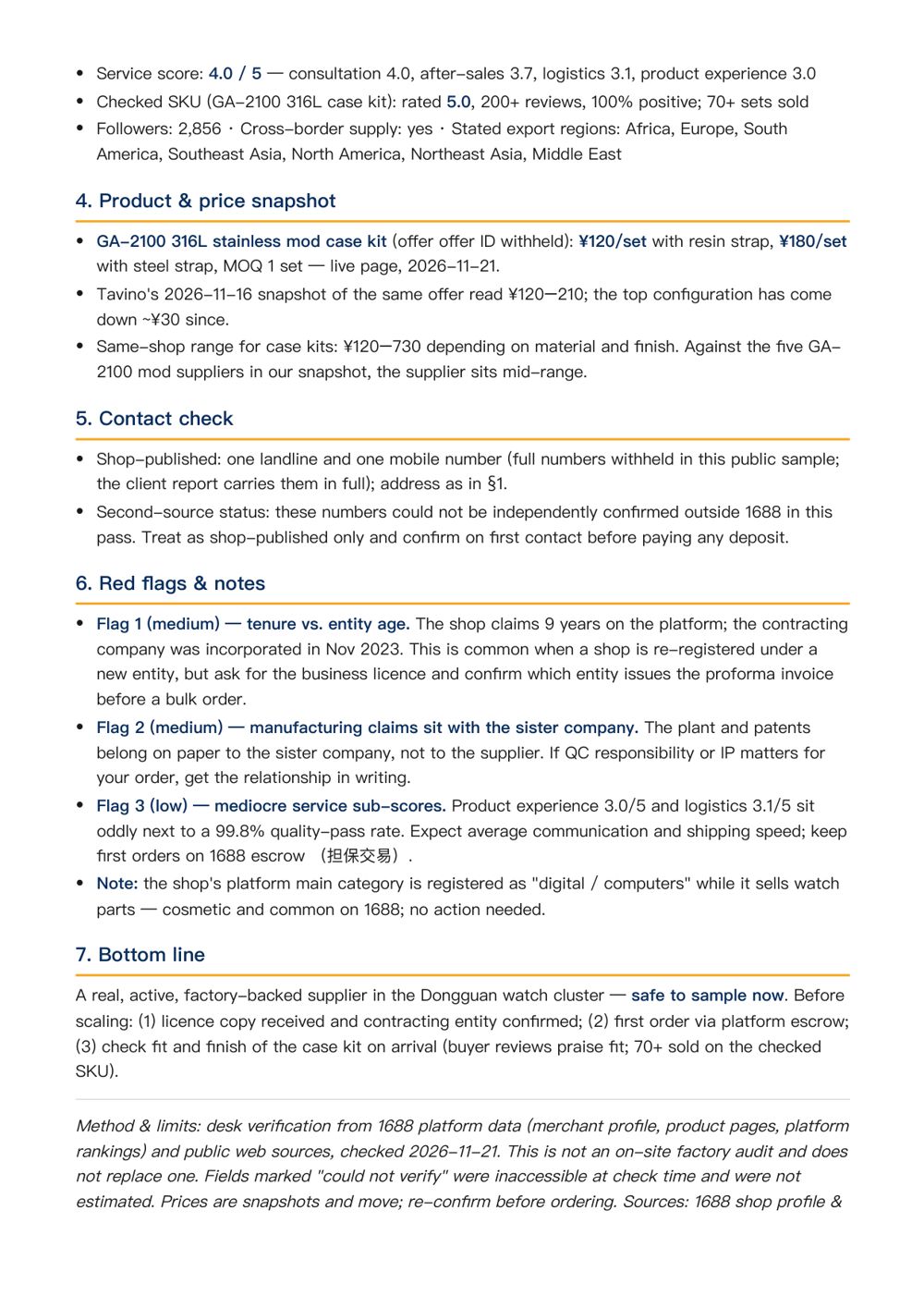
There was also one small oddity worth a line: the shop's main category is registered as digital/computer products, for a watch-parts seller. Probably an account-setup artefact. Harmless — but a report should note the oddities it cannot explain, rather than quietly dropping them.
If a verification report you receive — from anyone — contains no "could not verify" section, you are reading an advertisement.
What should you do with a "partially verified" supplier?
The verdict on the Dongguan supplier was Partially Verified — and that is the most common outcome of a real check, so it is worth knowing how to act on it.
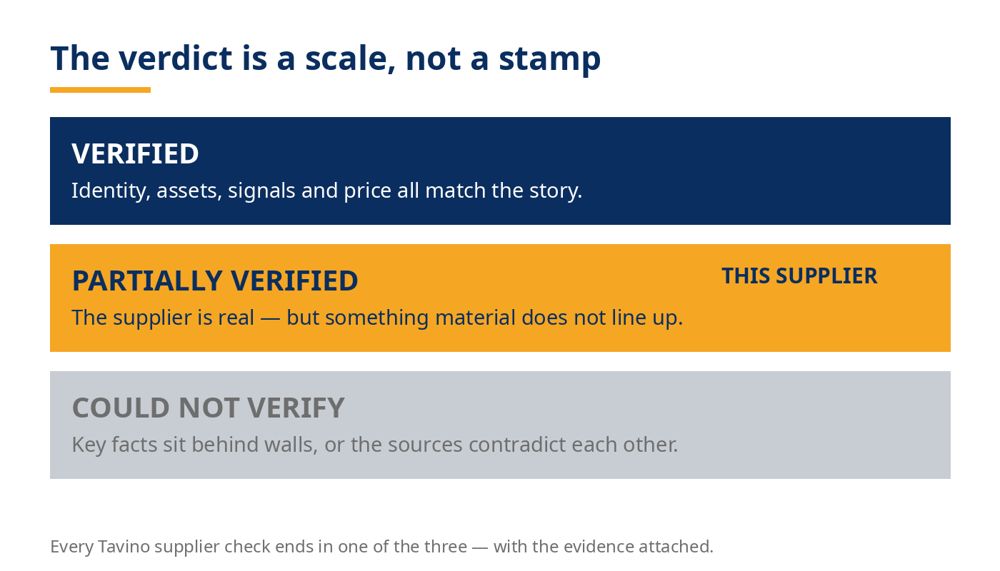
• Proceed, but resize the risk. The entity is younger than the storefront implies, so the first order should be sized for a two-year-old company, not a nine-year one.
• Sample before production. With single-piece orders available at ¥120–180, there is no excuse for skipping this. Inspect the kit on a real watch before committing.
• Keep payment on-platform. 1688's trade assurance exists precisely for the gap between "looks real" and "proven". Off-platform payment removes your only leverage.
• Re-check the price on payment day. A quote from last week is history. The ¥210 → ¥180 move in this case worked in the buyer's favour; it goes the other way just as often.
• Put the sister-company question in writing. Ask which entity issues the invoice and which entity manufactures. The answer — and whether it matches the registry — tells you a lot about how the supplier handles direct questions.
None of this requires being in China, speaking Chinese, or flying to a factory. It requires an hour of desk work against sources the seller does not control — done before the deposit, not after the dispute.
The five checks, in order
To compress this article into a checklist:
1. Registry first. Legal name, incorporation date, business scope, status. This tells you who you are actually contracting with.
2. Separate the shop's age from the company's age. A gap is not fraud, but it reprices your first order.
3. Read the platform's performance data, not its badges. Repeat-purchase rate, inspection pass rate, fulfilment, and the service-score breakdown.
4. Price against a same-day market band. Six shops minimum, and re-check on the day you pay.
5. Write down what you could not verify. Then size your order so the unverified parts cannot hurt you badly.
The Dongguan supplier passed enough of these to earn a (resized) order. That is what verification is for — not a binary stamp of good or bad, but a price on the risk you are actually taking.
I run this exact check as a fixed-price service — registry, platform signals, price band and a written could-not-verify section, delivered as a short report: Supplier Check on Upwork. If you would rather do it yourself, the checklist above is the whole method — the only ingredient it really needs is the hour.